Group Tours | Archaeology | History | Resources
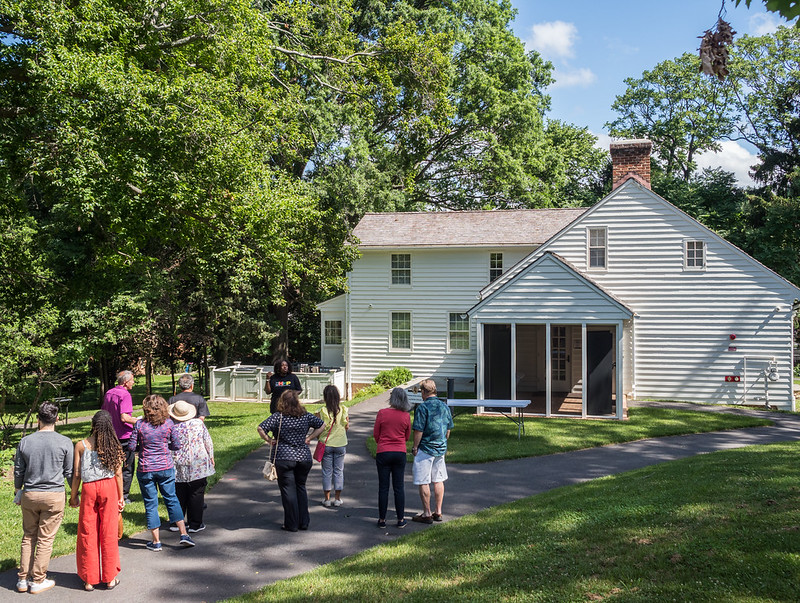
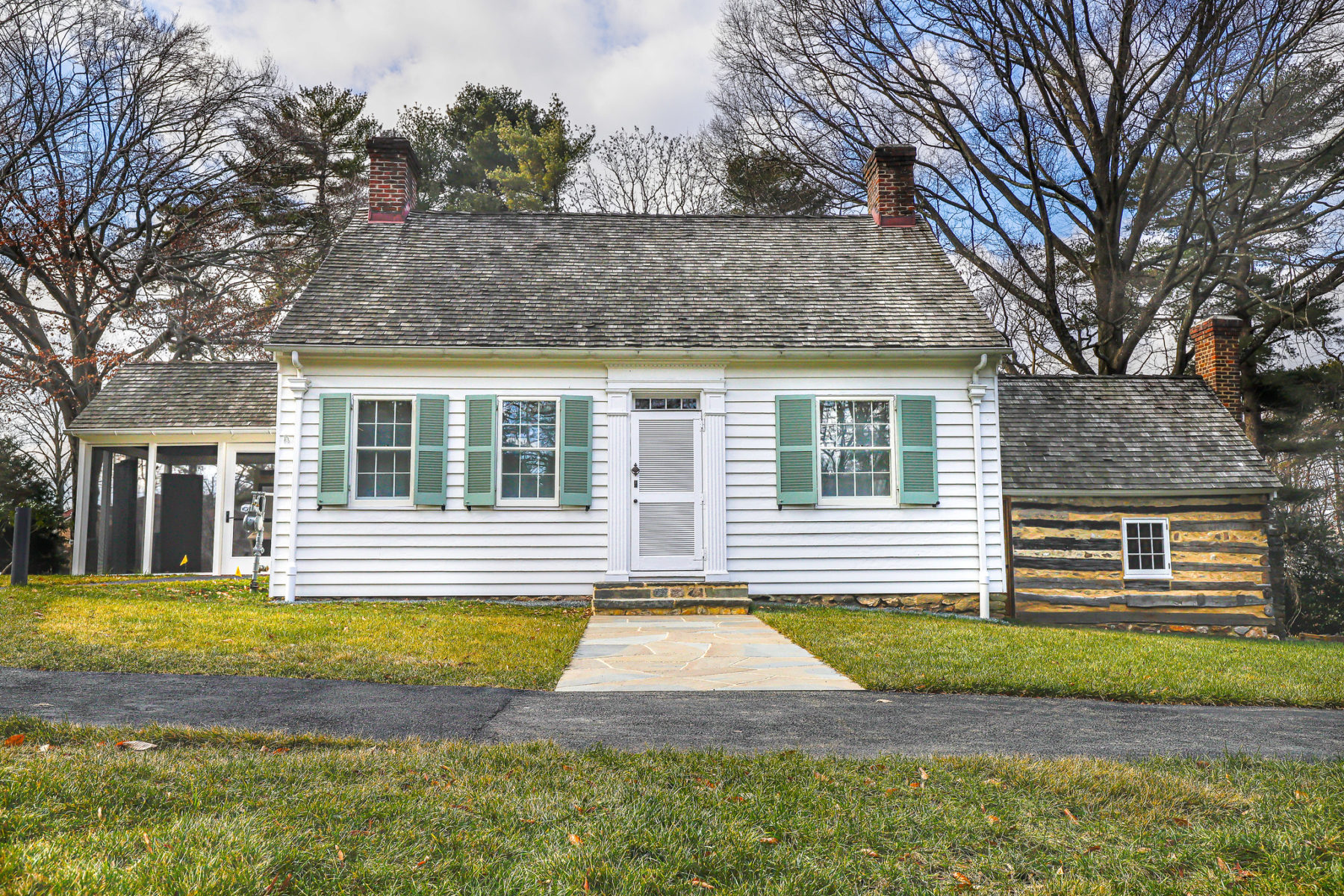
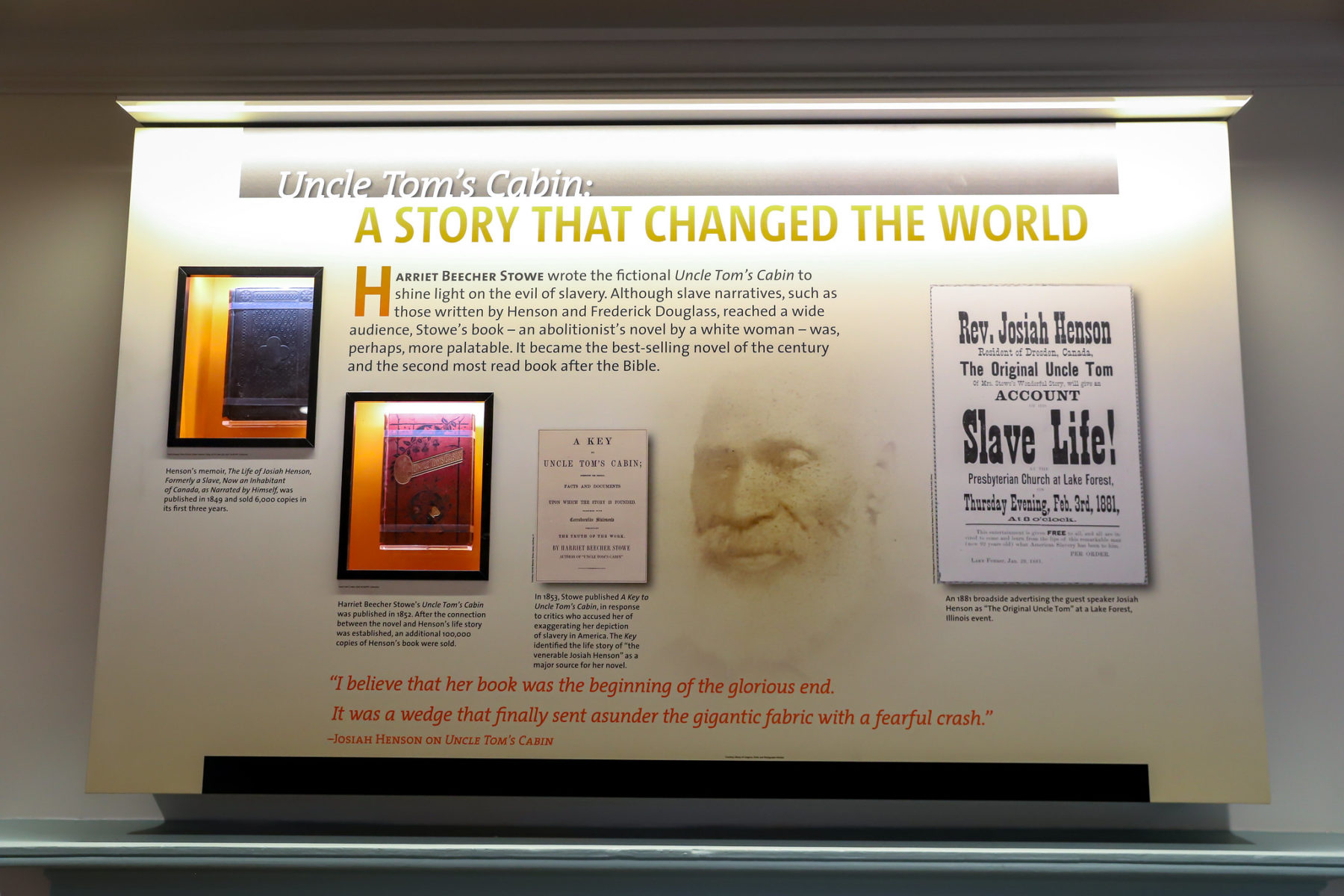
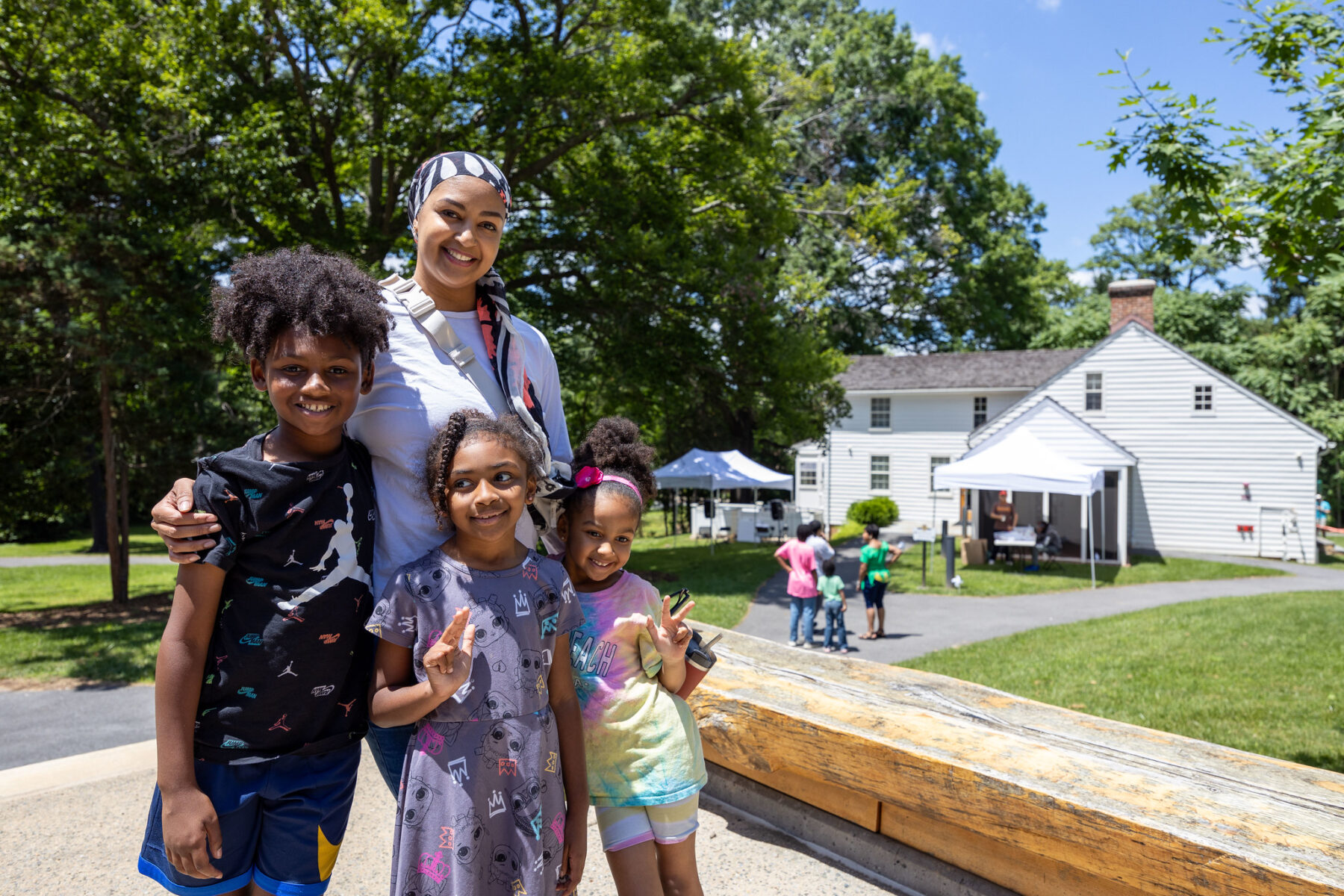
Josiah Henson Park is the former plantation property of Isaac Riley where Reverend Josiah Henson was enslaved. This park is a historic resource of local, state, national and international significance because of its association with Reverend Henson, whose 1849 autobiography, The Life of Josiah Henson, Formerly a Slave, Now an Inhabitant of Canada inspired Harriet Beecher Stowe’s landmark novel, Uncle Tom’s Cabin. The Park contains the historic Riley/Bolten House (1800-1815) and its attached log kitchen (1850-51).
The Josiah Henson Park is part of the National Park Service National Underground Railroad Network to Freedom program.
After extensive public outreach a master plan for the development of Josiah Henson Park was approved and adopted in December 2010. Park Development Division has since completed the design planning for this park. Visit the project web page for information on the progress of this project.
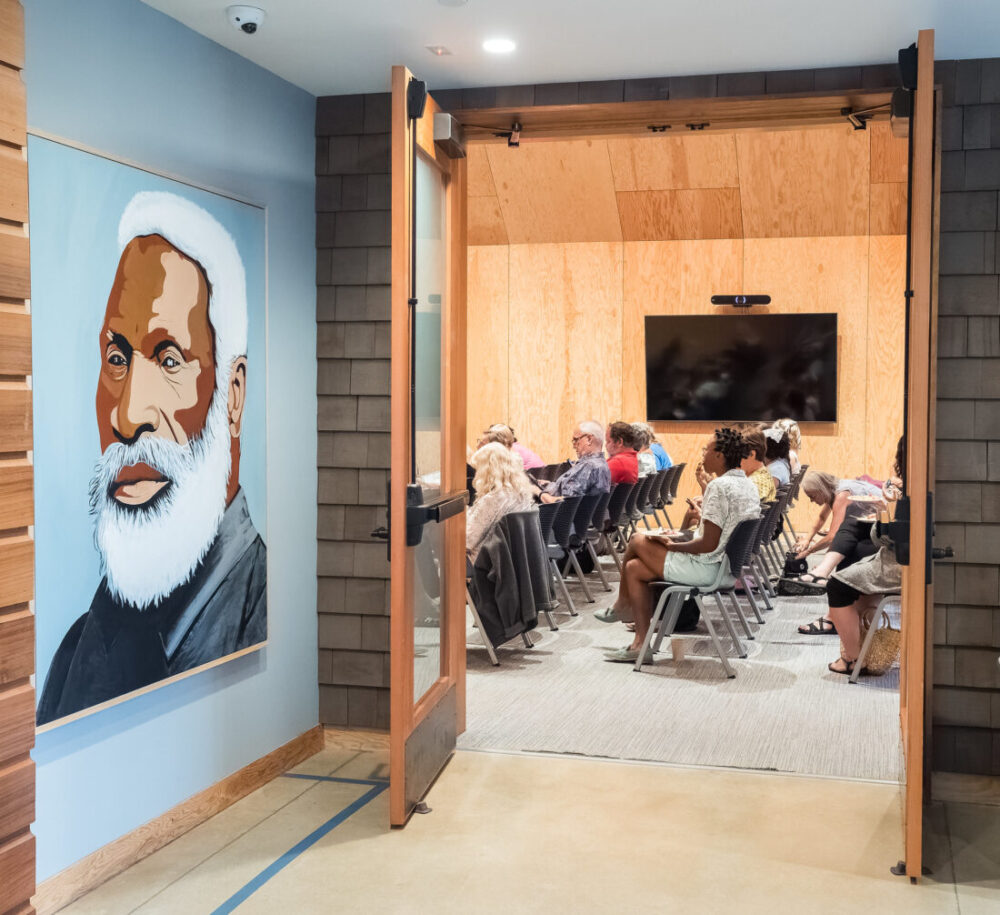
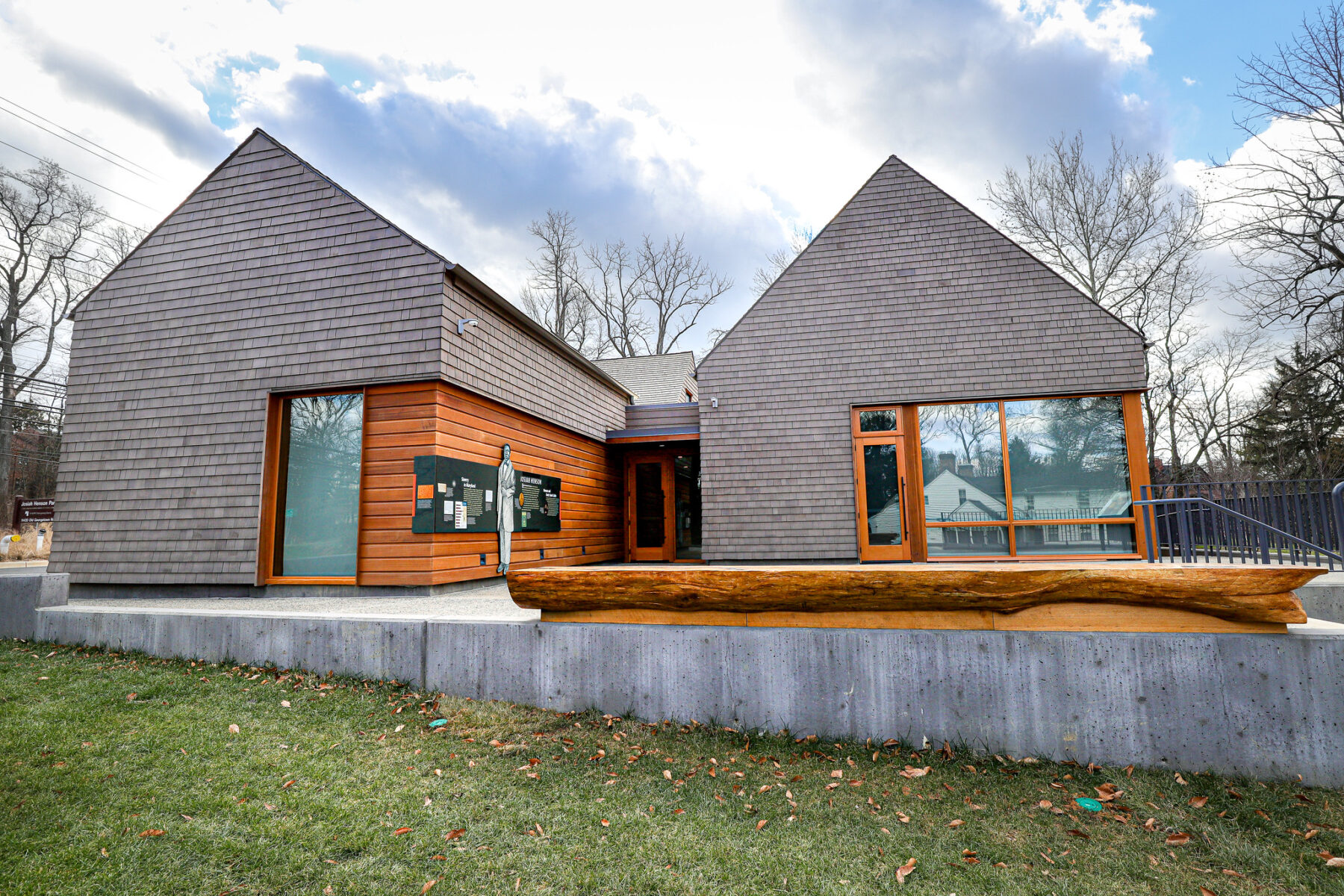
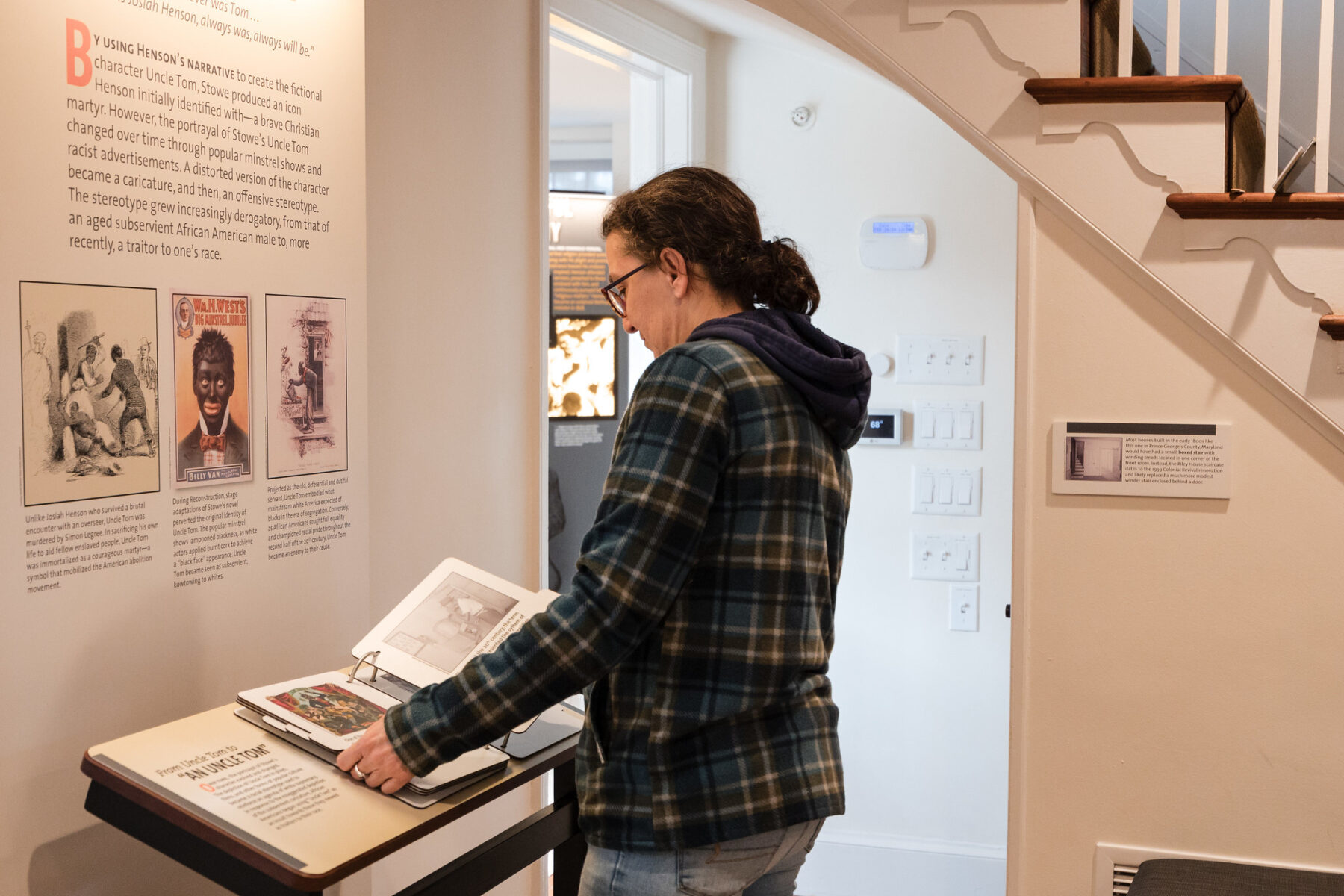
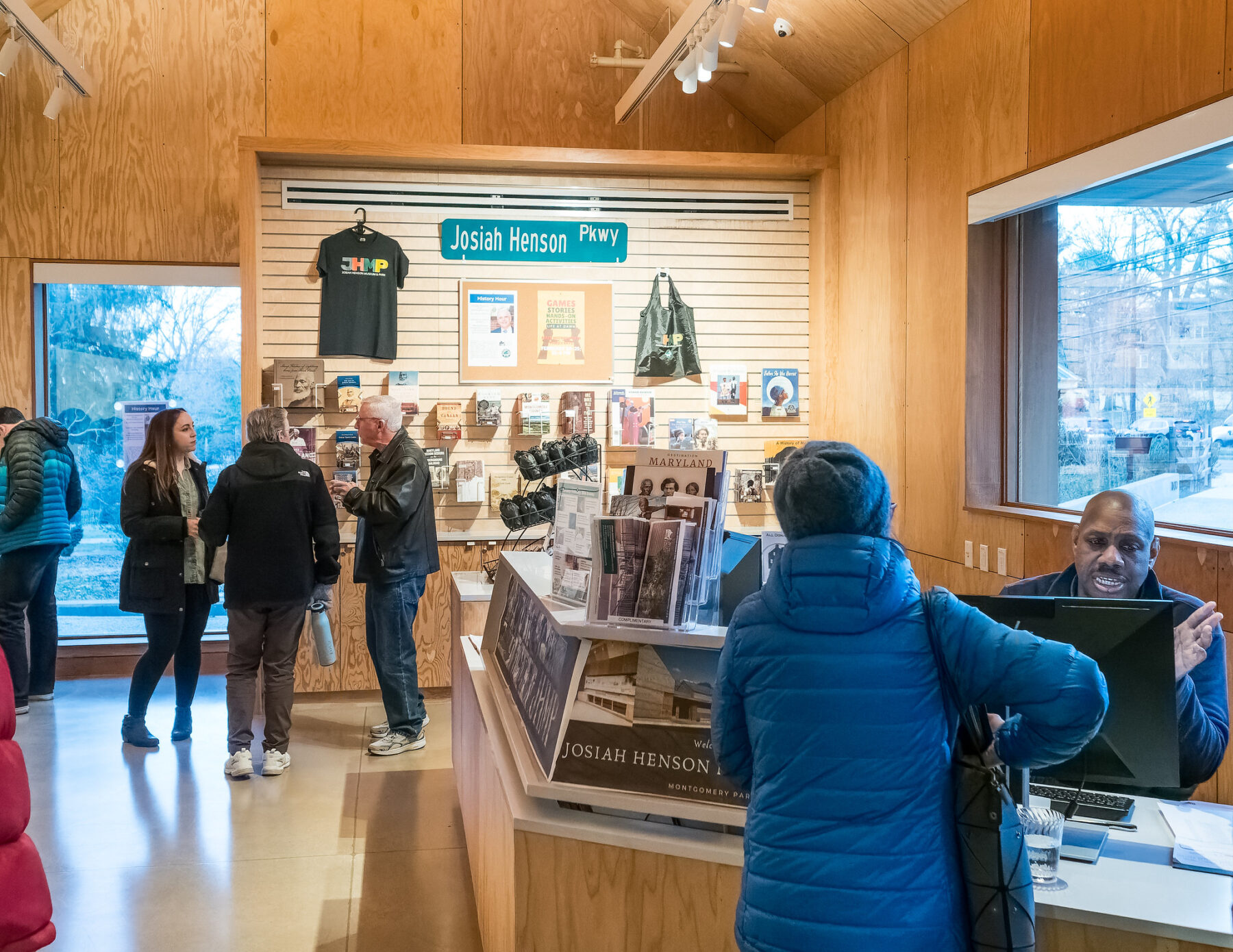
We need your help! The Josiah Henson Park is on the verge of becoming a world-class museum and education center. Construction begins this winter on the new Visitor Center on the site, along with rehabilitation of the Riley/Bolten House with new museum exhibits featuring Reverend Henson’s life and the history of slavery in Montgomery County and Maryland.
Commemorative Pavers will be available in three sizes:
Follow in the footsteps of Reverend Henson and support his legacy to enlighten and educate the next generation. Dedicate an engraved paver that will be placed along the Josiah Henson “Footsteps to Freedom” path used as part of the way-finding program of the Josiah Henson Park in perpetuity. Visit the Foundation web page for more information.
Order yours today!
Due to the upcoming construction at the Henson Park, onsite group tours and field trips have been suspended until the museum project is completed and no tours or programs will take place at the park. We apologize for any inconvenience and appreciate your patience as we move forward with this exciting project.
NEW! History-In-A-Box School Program begins 2019
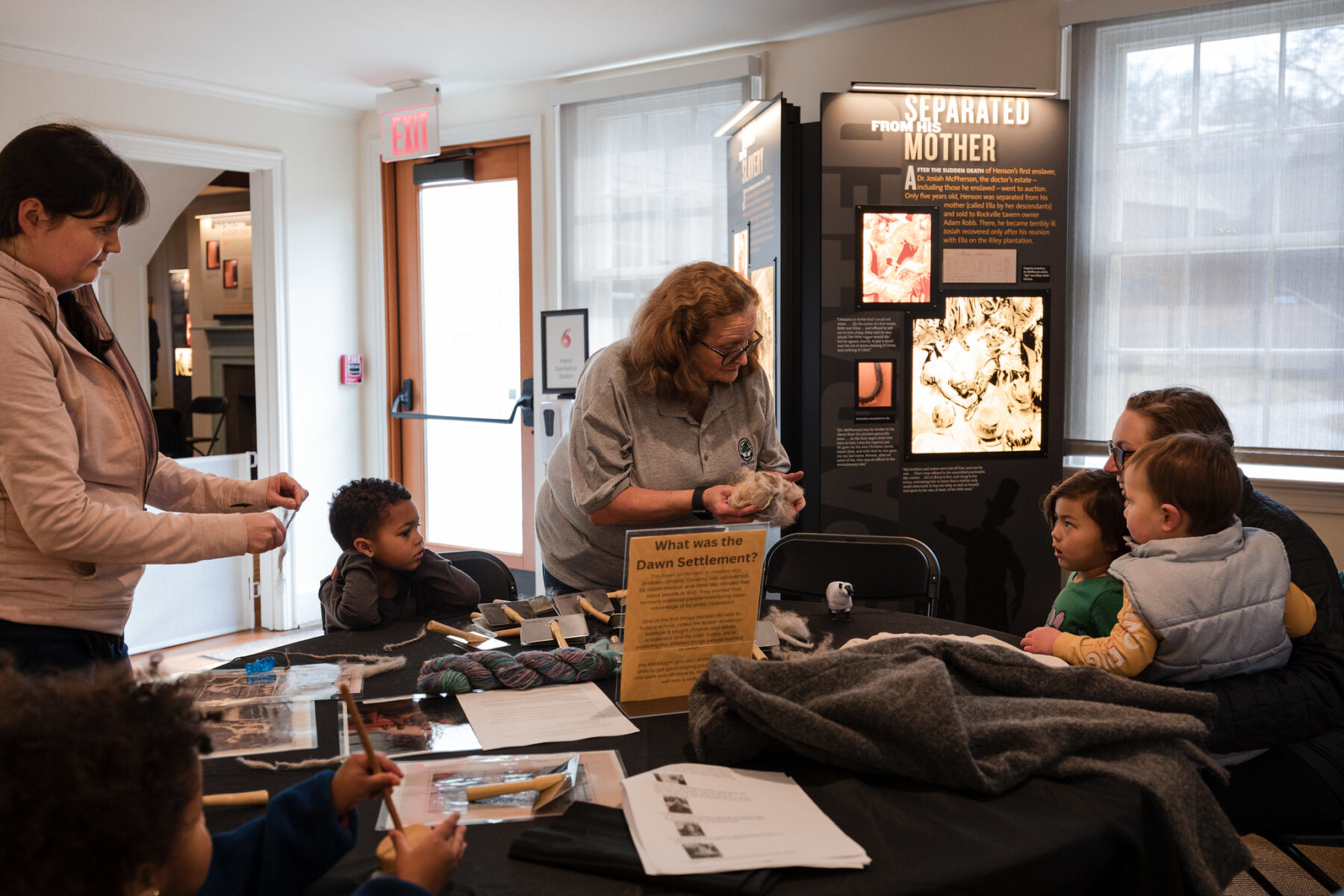
Parks will offer a new classroom experience that focuses on the popular school field trip program, “Searching for Josiah Henson” for students grades 4th – 8th. Our new History-In-A-Box program has hands-on activities that link students to the archaeological excavations that have taken place at the park over the past decade, as well as providing an engaging introduction to the life of Rev. Josiah Henson. Groups can register online for this program in November 2018.
Parks also offers guided tours of the historic sites for older students and adult groups. Register online, email: HistoryTours@montgomeryparks.org or call 301-650-4373 for more information. All tours will be presented by trained guides who will make history come alive for your group.
The Josiah Henson archaeological site was one of four American sites selected by the PBS series, “Time Team America” for inclusion in their second season during 2012. The Time Team America crew brought their high-tech equipment to help Park archaeologists learn more about a very special man in American history, Reverend Josiah Henson. The resulting documentary, “The Search for Josiah Henson“, is an over-the-archaeologists’-shoulder view of discoveries made at our very own Josiah Henson Park!
Please follow the schedule of special events for the Henson Park to find out dates when the documentary will also be shown on site.
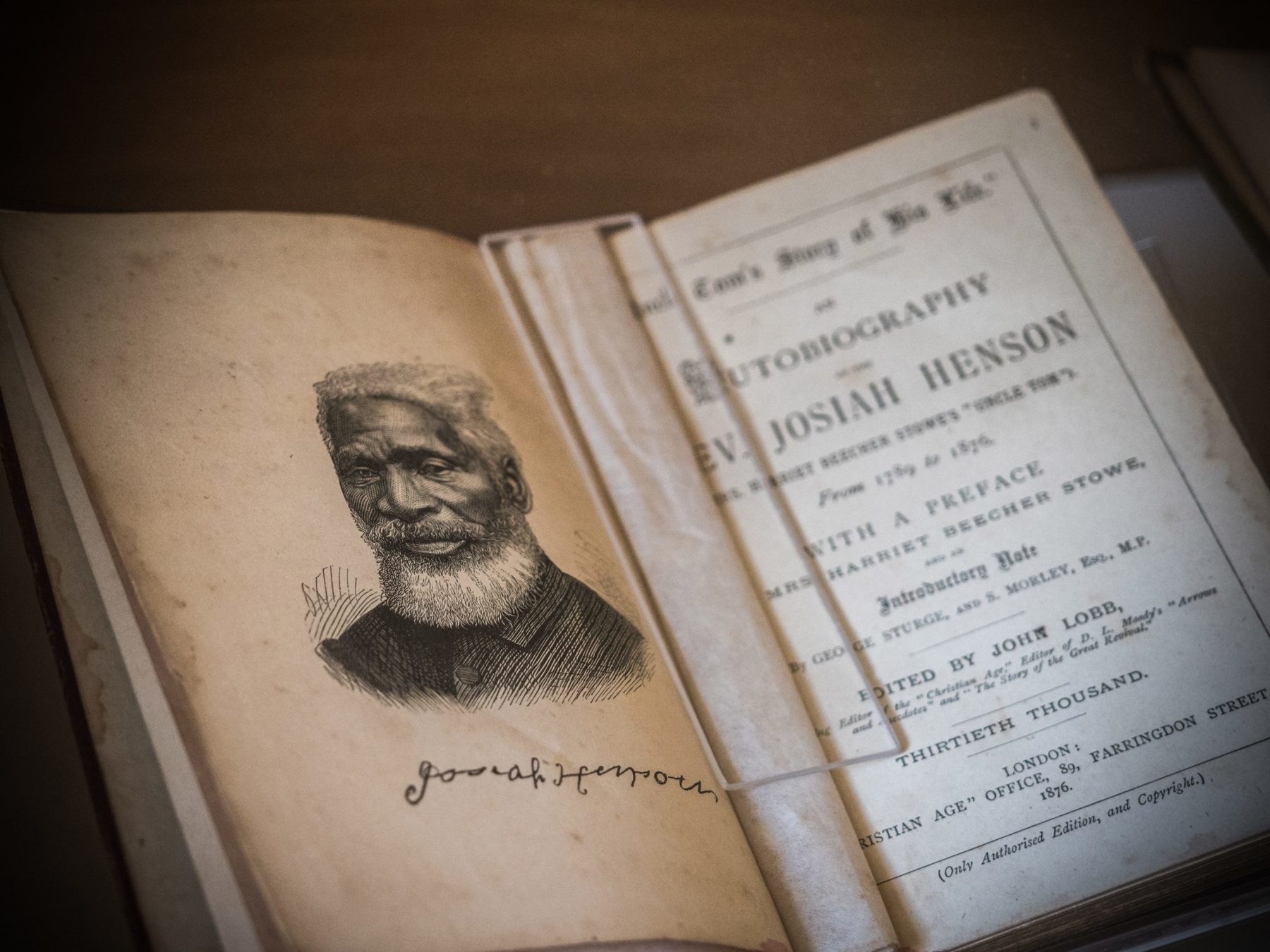
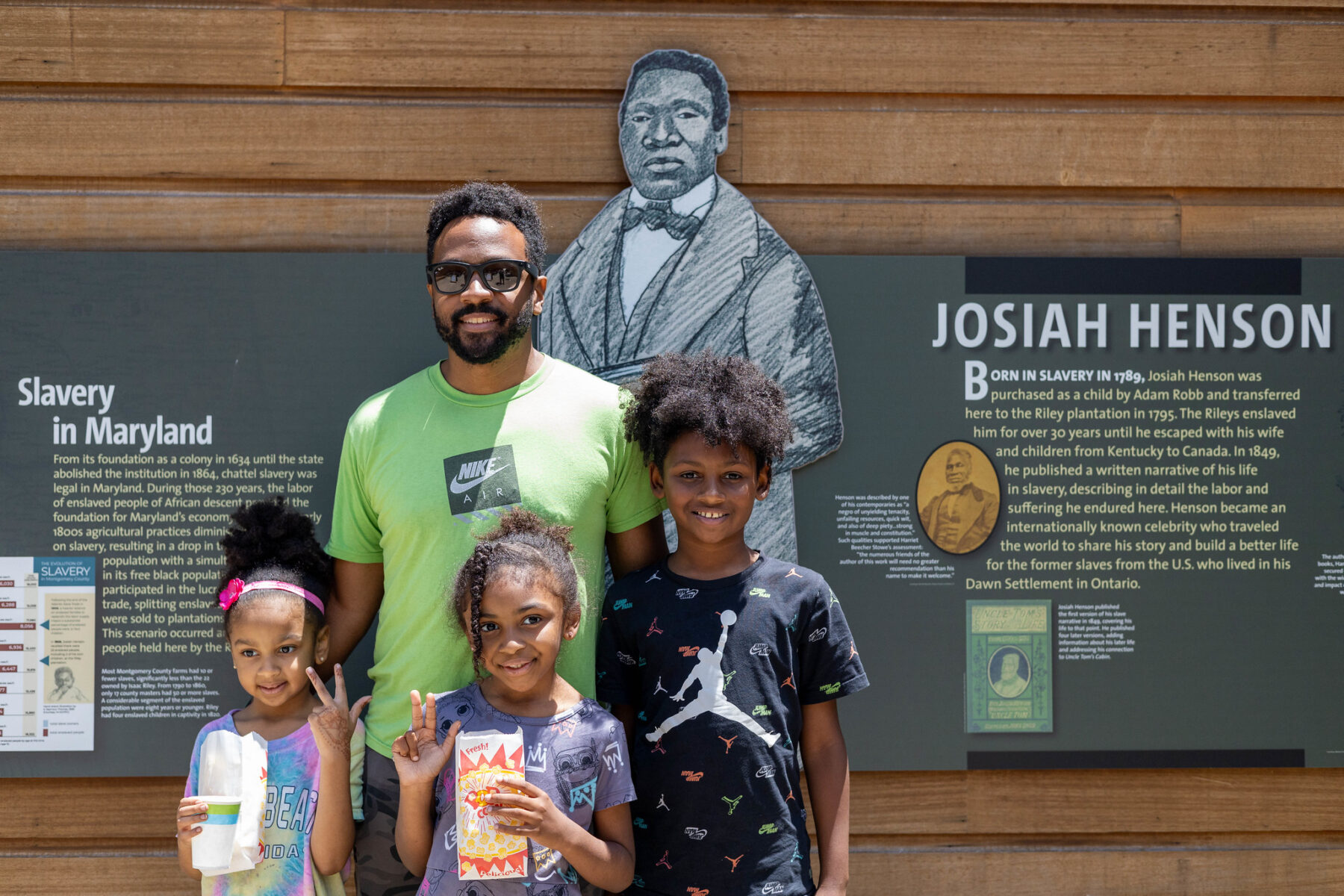
The Josiah Henson Park is the former plantation property of Isaac Riley where Reverend Josiah Henson was enslaved from 1795 – 1830. It is also a historic resource of local, state, national and international significance because of its association with Reverend Josiah Henson, whose 1849 autobiography, The Life of Josiah Henson, Formerly a Slave, Now an Inhabitant of Canada, as Narrated by Himself, inspired Harriet Beecher Stowe’s landmark novel, Uncle Tom’s Cabin.
Ongoing archaeological excavations seek to find where Josiah Henson may have lived on the site. Josiah Henson’s quarters, described by him in his autobiography as a “log hut,” and part of a “village of log huts” were located somewhere on the plantation grounds.
The house in the park that stands is the slave-owning family’s house that date from 1800-1815. It is also known as the Riley/Bolten House for its later owners as well, and is listed as such on the National Register of Historic Places. The Boltens altered the house to give it a Colonial Revival appearance and put on a rear addition between 1936 – 1939.
That house features an attached log kitchen that has been dated by tree-ring analysis to 1850. Given that 1850 is after Henson’s 1830 escape to Canada, but before emancipation in Maryland, it is assumed that enslaved people, such as a cook,would have worked in the kitchen and that the cook’s family slept in a loft above the kitchen, which was known to exist, but is now removed.
The log kitchen also is the site of an interior archaeological dig, which has discovered three previous earthen floors inside the kitchen space. These earlier dirt floors indicate the presence of an earlier kitchen that stood on the very same spot as the current one.
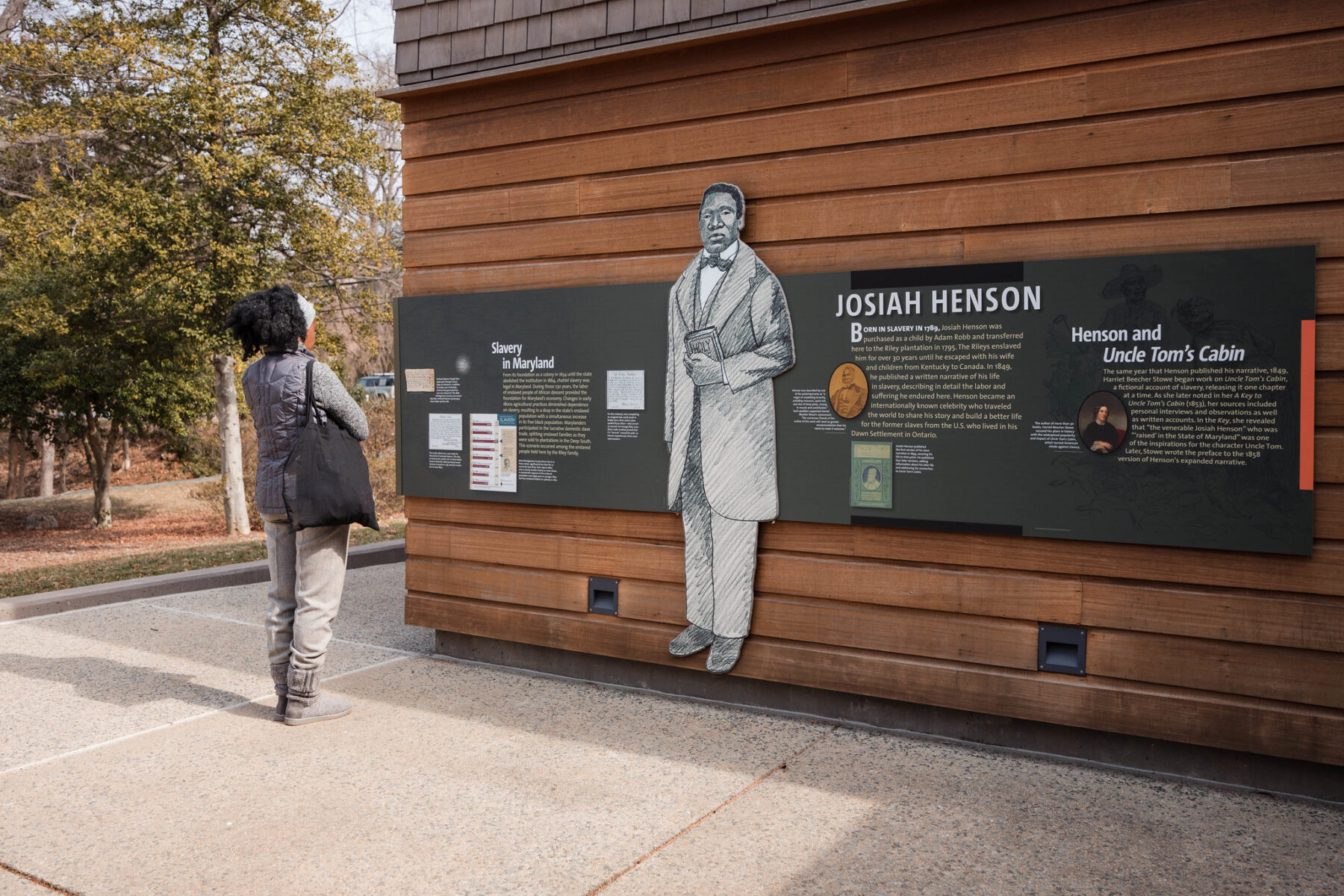
Many of Henson’s experiences of living as a slave on the Riley plantation are vividly depicted in his autobiographies and are recreated in Stowe’s novel. Henson eventually escaped to Canada in 1830, where he established a fugitive slave community called Dawn, continued his work in the Methodist ministry, and became a speaker and writer. He led 118 from enslavement in the United States to freedom in Canada as a conductor on the Underground Railroad.
The impact of Stowe’s novel, Uncle Tom’s Cabin, should not be underestimated. Published in 1852, it broke all sales records of the time and sold over half a million copies by 1857. It inspired and inflamed the abolitionist movement in the mid-19th century and many believe it helped to propel the American Civil War.
Because of the historical associations of the Josiah Henson Park, it is among very few properties in Montgomery County that conjures up images of slavery and the slave experience. The goal for the interpretation of the Josiah Henson Park is to accurately portray Henson’s life and the Maryland slave experience as well as to explore the impact of Stowe’s novel. The realization of this goal will have a permanent educational benefit.
The Josiah Henson Park had been in private ownership for its entire history, until it was acquired by the Montgomery County Department of Parks, part of the Maryland-National Capital Park and Planning Commission (M-NCPPC) in January 2006. The building and site are protected by public ownership and M-NCPPC is committed to excellent stewardship of this resource.
The Montgomery County Planning Board held a Planning Board Work Session on December 2, 2010 where it approved/adopted the master plan and the recommended name change from “Uncle Tom’s Cabin” Special Park to Josiah Henson Special Park. Read the Josiah Henson Special Park Master Plan (PDF) for more information.
The Riley/Bolten House was listed on the National Register of Historic Places in 2011 for its historic significance. It is considered to have irreplaceable cultural, material, and aesthetic value.
In 2011, the Department of Parks initiated a Facility Plan project for the Josiah Henson Park. Parks is committed to excellent stewardship of this resource because of its historical associations with slavery and the slave experience in Montgomery County. The Park Development Division is working with a team of consulting architects, engineers, and interpretive program planners to complete a Facility Plan level of work to develop, preserve, rehabilitate, restore the park site and buildings, and begin the development of a new museum at the park.
The Facility Plan was approved by the Planning Board and County Council in June 2013 and work will begin in 2016 on the subsequent final design and construction phases. For information, visit the Josiah Henson Park Facility Plan Project website.
| Date | Acquisition & Research |
| 2006 | Riley Farm Property Acquired |
| June 2008 | Historic Structure Report Completed |
| October 2008 | Dendrochronology -Completed |
| 2009 | Rozier Property Acquired |
| December 2010 | Josiah Henson Special Park Master Plan (PDF) – Approved and Adopted |
| Spring 2011 | Facility plan Initiated. |
| June 2013 | Facility Plan – Completed and Approved |
| Summer 2016- Fall 2018 | Project Desgin and Permitting |
| Winter 2018 | Construction to Begin |
| Summer 2020 | Anticipated Park Opening |
In 2008 a Historic Structure Report was written to systematically and comprehensively document the property’s origins, physical materials, and archaeological yield. M-NCPPC contracted John Milner and Associates, Inc. to complete the necessary investigations. Their experienced team developed a detailed analysis of the building and grounds.
In this document you will find information on Reverend Josiah Henson, the Riley family, and on the structures and landscape of the site. As with all historical inquiries, research is ongoing. The site also underwent a “Design Phase” that explored all of the issues surrounding the conversion of the site from a private dwelling into a public cultural resource. Parks historians are investigating the history of the Henson site on a continual basis.
Electronic versions of Reverend Josiah Henson’s autobiographies are available online. Please follow the links below to read Henson’s historic narratives:
Trace Father Henson’s footsteps to his final home in Canada. Visit the Uncle Tom’s Cabin Historic Site in Dresden, Ontario to learn more about Reverend Henson’s life and work at Dawn Settlement in Canada.
This website uses cookies to provide you with an improved and personalized experience. By using this site you agree to our use of cookies. Please read our cookies policy for more information on the cookies we use and how to delete or block them.