Integrated Pest Management Program
To steward resources and manage pest issues on parkland, the department follows the principles of Integrated Pest Management (IPM). IPM is a science-based, environmentally sensitive approach that prioritizes long-term pest prevention and minimizes potential risks to people, property, and the environment. Our program combines multiple strategies and techniques such as mechanical removal of pests, cultural methods to improve soil and plant health, conserving and introducing beneficial biological controls, and when necessary, using pesticides.
The Parks Department does not use pesticides for cosmetic purposes. Pesticides are used as a last resort to control noxious and invasive pests, maintain safe and playable athletic fields and courts, and prevent significant economic damage, including degradation of park infrastructure.
Staff who apply pesticides and fertilizers are certified and registered with the Maryland Department of Agriculture. Montgomery Parks is committed to providing high-quality, safe recreational facilities and protecting and conserving our valuable natural and cultural resources to meet the needs of current and future generations.
What is Montgomery County Code 33B?
County Code Chapter 33B went into effect on July 1, 2016. The code presents guidelines for pesticide use in Montgomery County, including on county property and parkland. The goal of the code “is to inform the public about pesticide applications and minimize the use of pesticides for cosmetic purposes, while not restricting the ability to use pesticides in agriculture, for the protection of public health, or for other public benefits.”
What is Montgomery Parks doing to comply with the law?
Montgomery Parks continues to implement IPM strategies to ensure pesticides are used as a last resort. Most of the park system’s 37,000 acres are managed without the use of pesticides. While IPM is practiced countywide, the department manages 54 parks and all 275 playgrounds using alternative, environmentally friendly methods.
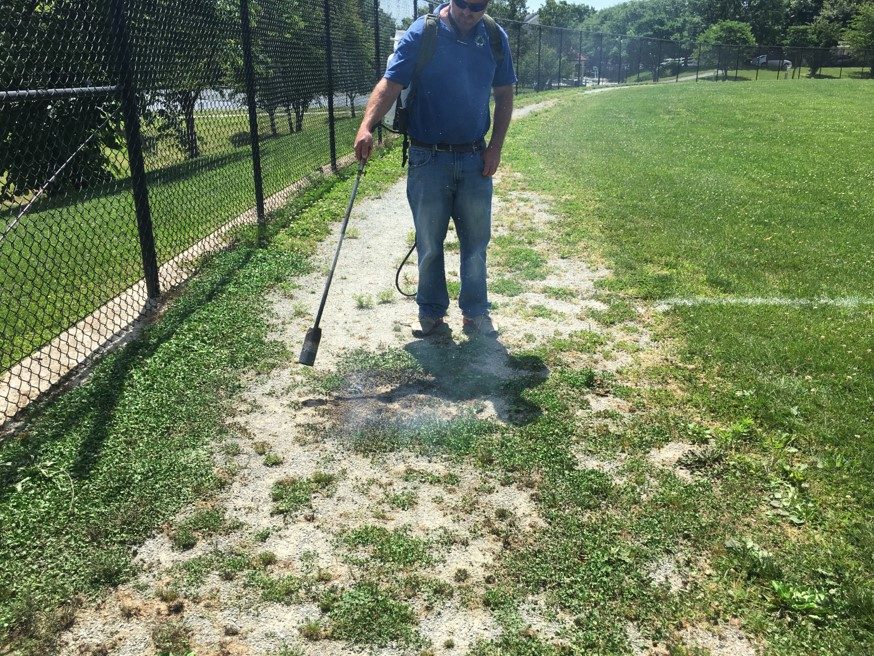
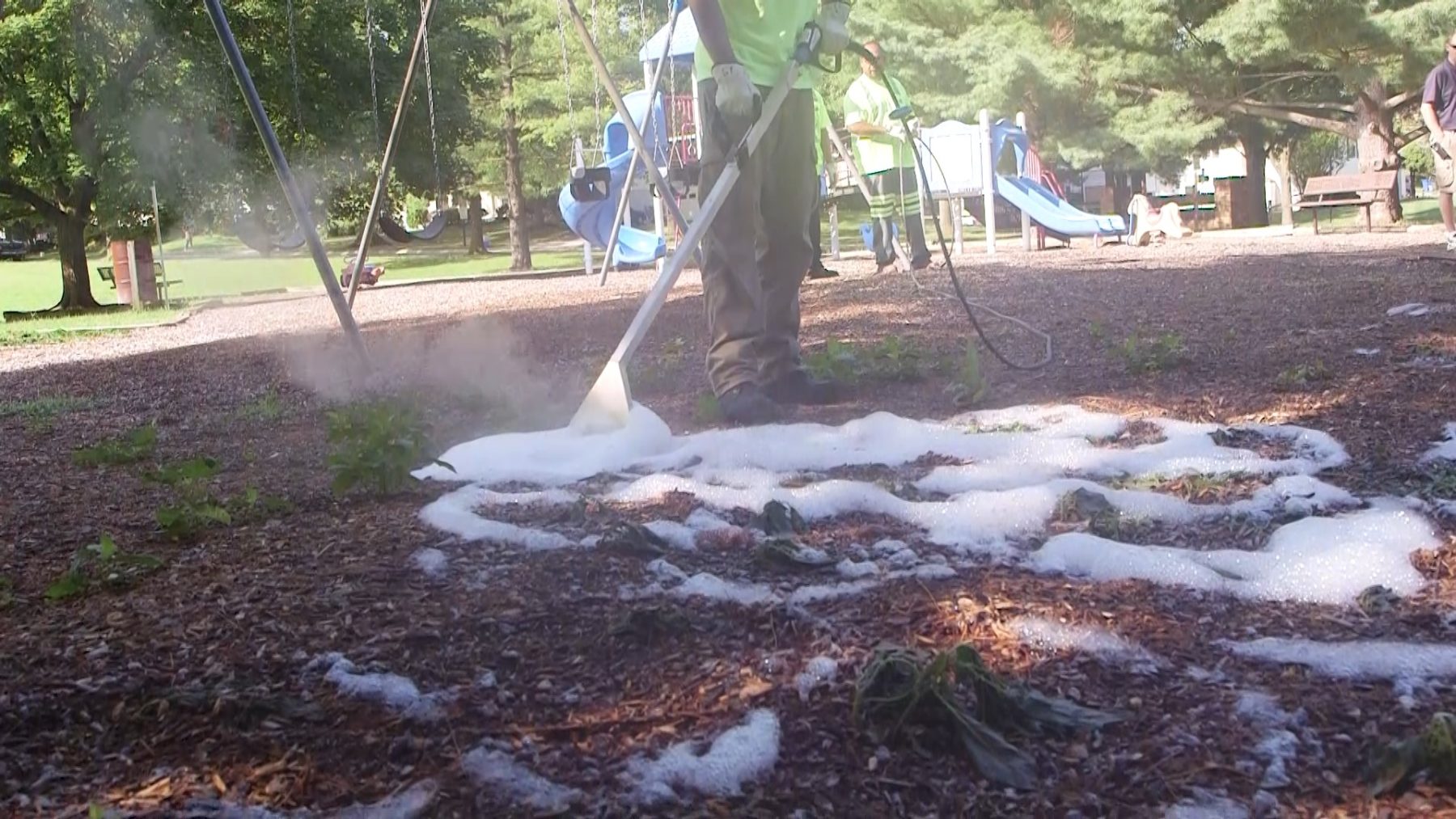
These methods include hot foam applications, string trimming, mechanical weed removal, and products approved for use by Montgomery County Code 33B. These approved products must be listed by the National Organics Standards Board or designated as a “minimum risk” pesticide under FIFRA 25(b). More information on “minimum risk” pesticides visit the U.S. Environmental Protection Agency.
This careful and balanced approach helps us ensure our parkland remains beautiful, resilient, safe, and open for public enjoyment.
When pesticides are deemed necessary, the public is notified of applications through our website. The table below includes a schedule of upcoming pesticide applications. This table is updated routinely to provide at least 48-hour notice of applications, except in cases of specific emergency applications like stinging insects harmful to human health. When emergency applications are made, the amenity is closed to the public during the application.
Montgomery Parks staff make every effort to notify the community on this webpage when a pesticide application is scheduled in a public area. Dates of applications may change or be canceled due to weather; also, occasional emergency applications (such as managing stinging insects harmful to human health) may be needed.
| Park Name | Planned Application Date Range | Planned Application Time | Area To Be Treated | Application Details |
|---|---|---|---|---|
| Brookside Gardens | 8/24-9/18 | 7 a.m. – 4 p.m. | Forests and associated peripheral garden planting areas | Garlon 3A will be applied to invasive weeds to restore habitat and protect ecosystem. |
| Brookside Gardens | 9/27 | 5:45 p.m. – 7:30 p.m. | North Conservatory permanent tropical plant collection | Isarid and Azadirachtin will be applied to insect pests to protect plantings. |
| Paint Branch SVU 5 | 9/8 – 9/29 | 7 a.m. – 5 p.m. | Restoration area PB-12 | Round Up Custom will be applied to invasive weeds – bamboo – to restore habitat and protect ecosystem. |
| Indian Spring Terrace Park | 9/14-9/21 | 7 a.m. – 5 p.m. | Restoration area Flower Ave. outfall | Vastlan and Round Up Custom will be applied to invasive weeds to restore habitat and protect ecosystem. |
| Bowie Mill Park | 9/8-9/18 | 7 a.m. – 2 p.m. | Tree rings | Prosecutor Pro will be applied to selective grass and broadleaf weeds to protect amenities and infrastructure. |
| River Road Shale Barrens Conservation Park | 9/7 – 9/18 | 7 a.m. – 3 p.m. | From River Road up the trail in and around the burn site | Aquamaster, Pathfinder II, and Garlon 3A will be applied to invasive weeds to restore habitat and protect ecosystem. |
| Brookside Gardens | 9/7 – 9/18 | 8 a.m. – 3 p.m. | Woodland areas behind Gude Garden | Aquamaster will be applied to invasive weeds to restore habitat and protect ecosystem. |
| Laytonsville Park | 9/8 – 9/18 | 7 a.m. – 2 p.m. | Tree rings | Prosecutor Pro will be applied to selective grass and broadleaf weeds to protect amenities and infrastructure. |
| Sundown Park | 9/8 – 9/18 | 7 a.m. – 2 p.m. | Tree rings | Prosecutor Pro will be applied to selective grass and broadleaf weeds to protect amenities and infrastructure. |
| Mount Zion Local Park | 9/8 – 9/18 | 7 a.m. – 2 p.m. | Tree rings and cracks in pavement | Prosecutor Pro will be applied to selective grass and broadleaf weeds to protect amenities and infrastructure. |
| Cherrywood Park | 9/8 – 9/18 | 7 a.m. – 2 p.m. | Tree rings and cracks in pavement | Prosecutor Pro will be applied to selective grass and broadleaf weeds to protect amenities and infrastructure. |
| Olney Square Park | 9/8 – 9/18 | 7 a.m. – 2 p.m. | Tree rings and cracks in pavement | Prosecutor Pro will be applied to selective grass and broadleaf weeds to protect amenities and infrastructure. |
| Norbeck-Muncaster Mill Park | 9/8 – 9/18 | 7 a.m. – 3 p.m. | Tree rings and cracks in pavement | Prosecutor Pro will be applied to selective grass and broadleaf weeds to protect amenities and infrastructure. |
| Flower Valley Park | 9/8 – 9/18 | 7 a.m. – 3 p.m. | Tree rings and cracks in pavement | Prosecutor Pro will be applied to selective grass and broadleaf weeds to protect amenities and infrastructure. |
| Rachel Carson Conservation Park | 9/8 – 9/18 | 7 a.m. – 3 p.m. | Tree rings | Prosecutor Pro will be applied to selective grass and broadleaf weeds to protect amenities and infrastructure. |
| Ridge Road Recreational Park | 9/14 – 9/18 | 7 a.m. – 3 p.m. | Fields #4, #5 | Three-Way will be applied to selective grass and broadleaf weeds for player safety. |
| Brookside Gardens | 9/14 – 9/25 | 7 a.m. – 4 p.m. | Forest/woods and planting beds along the Visitor Center parking lot | Prosecutor Pro will be applied to invasive weeds to restore habitat and protect ecosystem. |
| Germantown Town Center Park | 9/14 – 9/25 | 6:30 a.m.-2 p.m. | Landscape beds, lawn | Sedgehammer will be applied to nutsedge to protect plantings. |
| Germantown Square Park | 9/14 – 9/25 | 6:30 a.m.-2 p.m. | Landscape beds, lawn | Sedgehammer will be applied to nutsedge to protect plantings. |
| Owens Park | 9/14 – 9/25 | 6:30 a.m.-2 p.m. | Curbs, walkway, tennis court | Eraser will be applied to selective grass and broadleaf weeds to protect amenities and infrastructure. |
| Gunner’s Lake Park | 9/14 – 9/25 | 6:30 a.m.-2 p.m. | Curbs, walkway | Eraser and Razor Pro will be applied to selective grass and broadleaf weeds to protect amenities and infrastructure. |
| Germantown Town Center Park | 9/14 – 9/25 | 6:30 a.m.-2 p.m. | Landscape beds, stone beds, pavers | Eraser and Razor Pro will be applied to selective grass and broadleaf weeds to protect amenities and infrastructure. |
| Germantown Square Park | 9/14 – 9/25 | 6:30 a.m.-2 p.m. | Landscape beds, stone beds, pavers | Razor Pro will be applied to selective grass and broadleaf weeds to protect amenities and infrastructure. |
| Germantown Town Center Park | 9/14 – 9/25 | 6:30 a.m.-2 p.m. | Landscape beds, stone beds, pavers | Three-Way will be applied to broadleaf weeds to protect plantings. |
| Little Bennett Regional Park | 9/14 – 10/2 | 7 a.m. – 3 p.m. | Between the two large bridges on the Western Piedmont Trail, west of Clarksburg Rd.; on both sides of the trail and to the Little Bennett Creek | Aquamaster and Pathfinder II will be applied to invasive weeds to restore habitat and protect ecosystem. |
| Hoyles Mill Conservation Park | 9/14 – 10/2 | 7 a.m. – 3 p.m. | North of the stream and east of the Hoyles Mill Trail into the woods | Aquamaster and Pathfinder II will be applied to invasive weeds to restore habitat and protect ecosystem. |
| Brookside Gardens | 9/17 | 5:54 p.m. – 7:30 p.m. | North Conservatory permanent tropical plant collections | Isarid and Azaguard will be applied to insect pests to protect plantings. |
| Wheaton Regional Park | 9/17 – 9/23 | 5 a.m. – 3 p.m. | Miniature train tracks | Prosecutor Pro will be applied to invasive weeds to protect amenities and infrastructure. |
| Brookside Nature Center | 9/18 | 8 a.m. – 10 a.m. | Garden beds immediately behind nature center and adjacent to the A/C compressors | Roundup will be applied to poison ivy to prevent harm. |
| Long Branch Park | 9/18 – 9/26 | 7 a.m. – 5 p.m. | Riparian area around Purple Line stream stabilization and new plantings | Vastlan will be applied to invasive weeds to restore habitat and protect ecosystem. |
| Brookside Gardens | 9/21 | 8 a.m. – 4 p.m. | Spot turf areas | Prosecutor Pro will be applied to selective grass and broadleaf weeds to protect amenities and infrastructure. |
| Veirs Mill Park | 9/21 – 9/25 | 7 a.m. – 5 p.m. | Reforestation areas that frame soccer and baseball fields | Roundup will be applied to invasive weeds to protect plantings. |
| South Germantwon Recreational Park | 9/21 – 9/25 | 6 a.m. – 3 p.m. | Pond | Seclear or Captain XTR will be applied to algae to restore habitat and protect ecosystem. |
| South Germantwon Recreational Park | 9/21 – 9/25 | 6 a.m. – 3 p.m. | Pond shoreline | AquaNeat or Diquat Herbicide, or Komeen or Flumigard or LI7000 will be applied to invasive weeds to restore habitat and protect ecosystem. |
| National Capital Tolley Museum property | 9/21 – 9/30 | 7 a.m. – 1 p.m. | Fenceline area | Prosecutor Pro will be applied to selective grass and broadleaf weeds to protect amenities and infrastructure. |
| Fountain Hills Park | 9/21 – 10/3 | 6:30 a.m. – 2 p.m. | Curbs, asphalt cracks | Eraser will be applied to selective grass and broadleaf weeds to protect amenities and infrastructure. |
| Royce Hanson Conservation Park | 9/21 – 10/9 | 7 a.m. – 3 p.m. | Forested area within the Putty Root Trail | AquaNeat will be applied to invasive weeds to restore habitat and protect ecosystem. |
| Brookside Gardens | 9/23 | 8 a.m. – 4 p.m. | Spot turf areas | Solitare will be applied to invasive weeds to restore habitat and protect ecosystem. |
| Northwest Branch Recreational Park | 9/23 – 9/24 | 7 a.m. – 5 p.m. | Reforestation area next to ICC | Roundup will be applied to invasive weeds to protect plantings. |
| Brookside Gardens | 9/24 | 5:45 p.m. – 7:30 p.m. | North Conservatory permanent tropical plant collection | Isarid and Azaguard will be applied to insect pests to protect plantings. |
On-site Signage Procedures:
- White prenotification signs are placed in advance of an application to playing fields, managed turf and treatments within 25 feet of a stream or creek. The signs list the planned application date, product, and the reason for the application.
- Yellow signs are installed at the site at the time of application and remain in place at least 48 hours following the pesticide application. For more information, call the phone number listed on the back of the sign.
- IPM Report 2026 Jan-June (Accessible PDF)
- IPM Report 2025 July – Dec. (Accessible PDF)
- IPM Report 2025 Jan. – June (Accessible PDF)
- IPM Report 2024 July – Dec. (Accessible PDF)
- IPM Report 2024 Jan. – June (Accessible PDF)
- IPM Report 2023 Jan. – June (Accessible PDF)
- IPM Report 2023 July – Dec (Accessible PDF)
- IPM Report 2022 Jan. – June (Accessible PDF)
- IPM Report 2022 July – Dec. (Accessible PDF)
- IPM Report 2021 Jan. – June (Accessible PDF)
- IPM Report 2021 July – Dec. (Accessible PDF)